


Important Information
Overview of essential installation requirements, safety guidelines, and component descriptions for proper boiler operation.
1. Circulation System – Open or Closed?
Open System: Requires an open expansion vessel mounted at the highest point. The vessel should accommodate 5–10% of the total system volume. Example setup shown below.
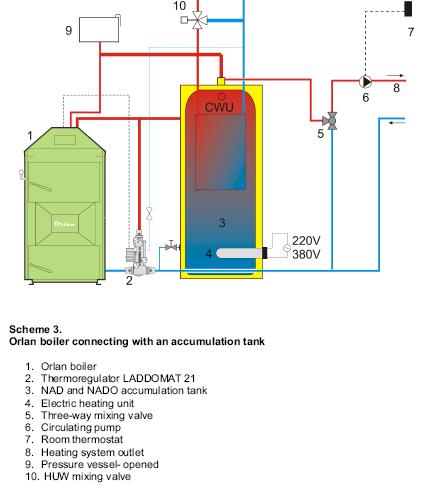
Closed System: Requires a pressurized expansion vessel (5–10% capacity). Must include at least one safety valve:
- 1.5 bar for boilers up to 65 kW
- 2 bar for boilers above 65 kW
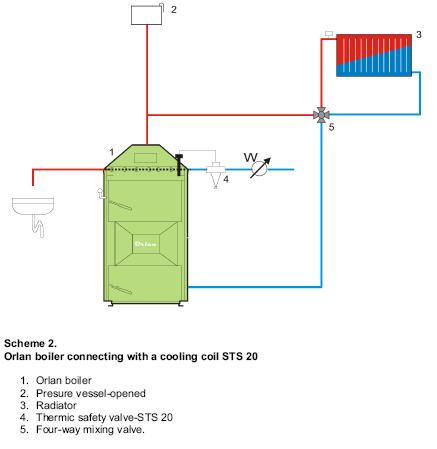
To prevent overheating, a cooling device is required. Two common solutions:
a) Cooling Circuit with One-Way Valve
Activates above 97°C to cool the entire system. Built-in for some models (e.g. Atmos, Orlan Super), optional for others (Dakon Dor, Ogniwo 12.6–20kW). Required for other steel/cast iron boilers along with a thermal release valve (e.g. Danfoss BVTS, Watts STS-20).
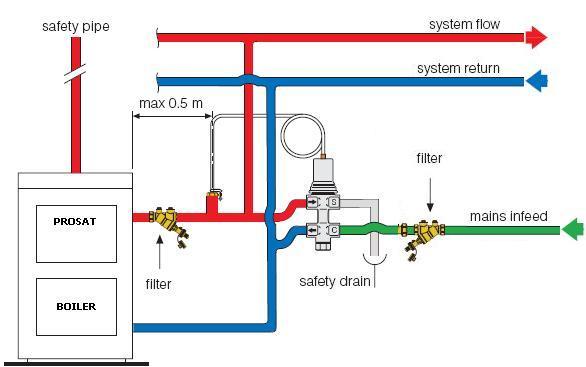
b) Two-Way Thermal Release Valve
Injects cold water and removes hot water simultaneously. Used in larger boilers (>50 kW). Must be positioned so its sensor touches moving hot water (activation: 95–97°C). Examples: Regulus DBV-1, Syr 5067, Caleffi 544.
2. Equipment
To ensure proper combustion, boilers may include:
- Draught Regulator: Mechanically adjusts air inlet according to target temperature
- Ventilator: Blows air into the combustion chamber, usually electronically controlled
Check the product page for what's included or optional.
3. Boiler with Automatic Fuel Feeder
Ideal for user comfort. Automatically fed retort burner provides optimal fuel combustion and clean exhaust. Simply refill the hopper every 3–10 days. Compatible with coal (5–25 mm screw feeders) or fine coal (piston feeders).
4. Mixing Valves
Three-way mixing valve: Installed at the return pipe to prevent corrosion by raising return water temperature. Can be manual or thermostatic. Ports 1 & 3 always allow circulation; Port 2 opens with rising temperature.

Four-way mixing valve: Offers return temperature protection and radiator temperature control by redirecting some hot water back to the boiler and returning some cooled water to the radiators.

5. Non-Warranty Components
Ceramic parts, cast iron components, sealing cords, and insulation materials are considered consumable parts and are not covered under warranty.
